
Stay in the know about wildlife, water quality, and ecosystems on Sanibel and Captiva Islands and in Southwest Florida
The Science of How Sea Turtles Hatch
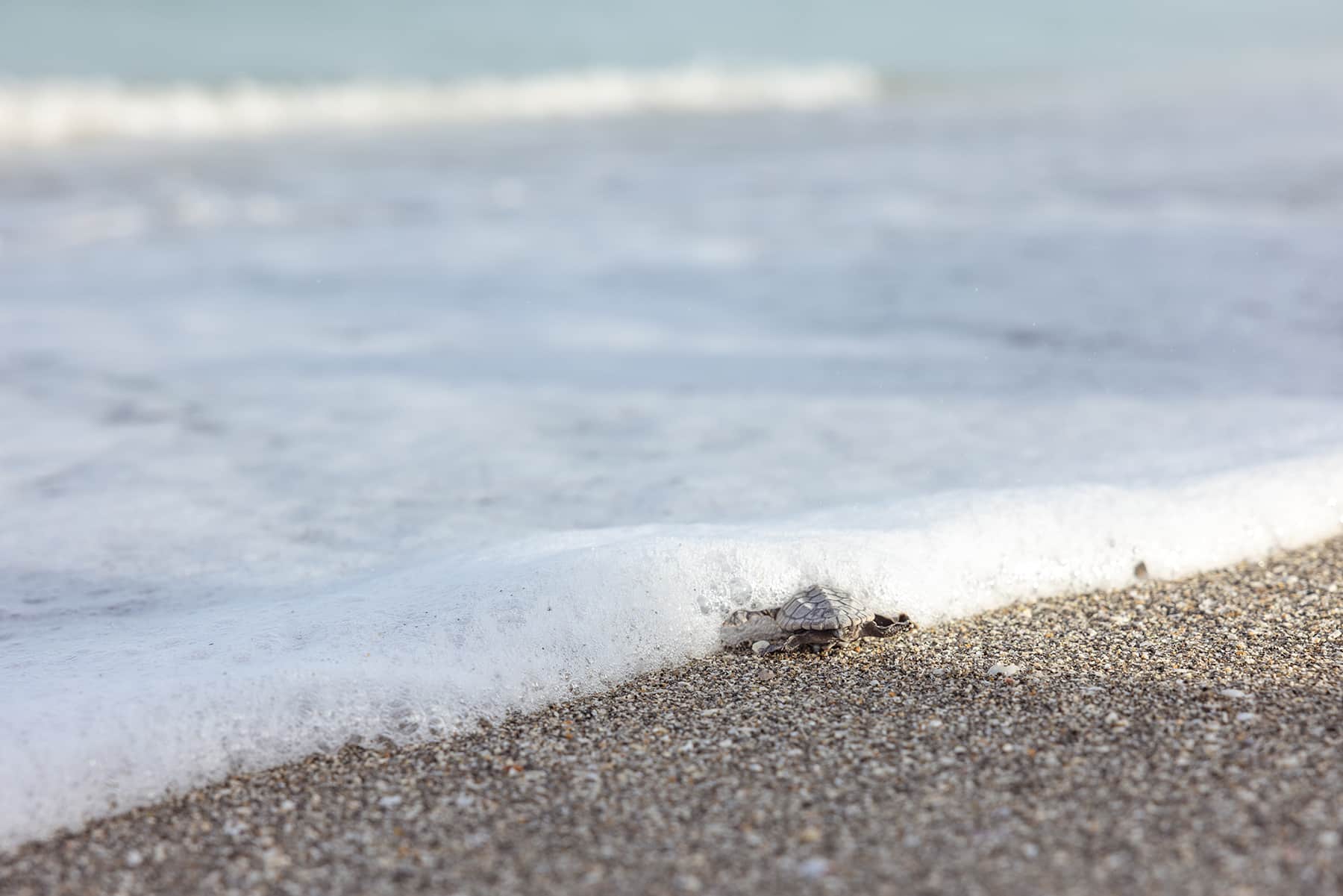
It’s now hatchling season on Sanibel and Captiva, as the first sea turtle nests of the season have begun to hatch. Since June 26, the islands have had 2,862 emerged loggerhead hatchlings (Caretta caretta)!
This season, the islands have had 798 sea turtle nests, including 14 green sea turtle (Chelonia mydas) nests, with the remainder being loggerhead nests.
Sea turtles have no maternal care, and after an adult female lays a nest of approximately 100 eggs, she never returns to check on her eggs or care for the offspring. Her eggs will incubate for a period of roughly two months.
“At that point, the hatchlings begin to ‘pip,’ or break out from their eggs, using a temporary ‘egg tooth’ called a caruncle,” said SCCF Sea Turtle Biologist Jack Brzoza. “They then stay partially in the egg as they absorb any remaining yolk sac, since yolk provides them with energy to tackle the long trek to the water and long swim to the open ocean.”
Once yolk has been absorbed — a process that may take place over the span of several days to a week — hatchlings exit their eggshells and begin emergence movements. Hatchling activity stimulates one another into periodic synchronized climbing efforts. They climb over and on top of one another, compacting fallen sand below them, which facilitates their ascension.
“Emergence from the nest typically occurs at night because the cooler sand temperatures spur greater hatchling activity,” Brzoza said. “Emergence at night also provides protection from the harsh sun and heat of the day, and there may also be a lower risk of predation. Erupting from the sand all at once offers extra protection through strength in numbers.”
To report issues with sea turtles or nests on Sanibel or Captiva, please contact the SCCF Sea Turtle Hotline at 978-728-3663.
Once on the surface, hatchlings immediately begin making their way to the ocean. When they finally hit water, hatchlings remain in their frenzy period, swimming several days nonstop in an attempt to reach the protection and foraging opportunities of the open ocean and sargassum mats.
“Hatchlings use a combination of cues to guide them to the water, with light being one of the strongest. They orient themselves in the brightest direction and historically, the reflection of the night sky on the water made seaward the brightest direction,” Brzoza said. “However, artificial light such as residential or commercial interior and exterior lighting, or urban skyglow, can cause a brighter horizon landward, attracting hatchlings away far away from the water and placing them at much higher risk for predation, over exhaustion, overheating, and additional anthropomorphic threats likes roadways, pools, and storm drains.”
In order to save hatchlings and help them successfully reach the water this hatching season, please remember the following:
- Turn off or shield all lights visible from the beach
- Close curtains and/or blinds after 9 p.m.
- Avoid using flashlights, and never shine them on hatchlings
- No flash photography or cell phone lights after 9 p.m.
- Fill in holes dug on the beach, flatten sandcastles, and remove beach equipment and furniture — all of which can pose a hazard to hatchlings
- If you happen upon hatchlings making their way to the water, give them plenty of space and do not handle or move them