Stay in the know about wildlife, water quality, and ecosystems on Sanibel and Captiva Islands and in Southwest Florida
Wet Season Is Here: Sanibel is Less Salty and Water Levels Are Higher
SCCF’s Marine Lab reports that the onset of the wet season has helped refresh inland water bodies, but they are still quite salty.
Following this year’s dry season, which was fairly dry, inland waterbodies on Sanibel did not receive much relief from the three storm surges in 2024.
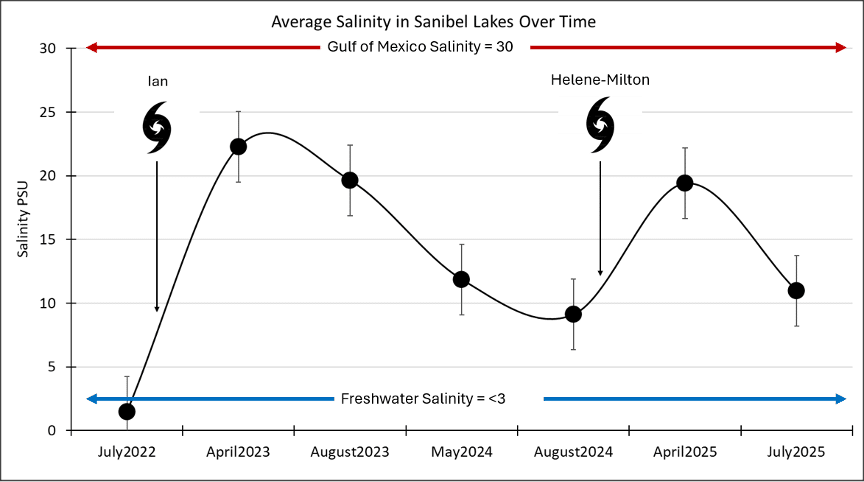
The average saltiness for inland water bodies jumped up to a salinity of 20 PSU (practical salinity units) over the dry season. This is about 65% sea-water strength (>30 PSU) and a lot saltier than fresh water (< 3 PSU).
“Many of us were hoping for significant rain in last year’s wet season to begin the conversion of our salty lakes and wetlands to fresh again. After Ian, it took over two years and record rainfall to recover some of the freshwater wetlands and lakes. But TS Debby, and Hurricanes Helene and Milton last summer ended that progress and our freshwater systems became salty again,” explains SCCF Research Associate Mark Thompson.
June 2025 was good for Sanibel freshwater systems, with between 7 and 10 inches of rain. During this period, the average salinity of lakes on Sanibel fell from 20 to 11 PSU.
“We are halfway to fresh again, and the remainder of the wet season can bring additional relief. As we found after Ian, the larger lakes with small watersheds, such as Murex Lakes and Palm Lake, are very slow to become fresh again,” said Thompson.
These lakes are not natural, having been dug to provide fill for the surrounding homesites. Because they are deep and have a large volume of water, which was converted to saltwater during the surges, they need a large volume of precipitation and runoff to once again become fresh. The small watershed reduces the amount of rainfall that flows into these lakes compared to other waterbodies.
“Natural wetlands and lakes have a much larger watershed-to-depth ratio,” he said.
The Sanibel Slough is also a man-made feature, dug in the 1940s to connect wetlands.
“Even though the Sanibel Slough was dug to be a deep channel, it has a large watershed, and the salinity has been reduced from around 20 PSU to 7-10 PSU now. Freshwater plants and animals will soon be seen again in the slough,” Thompson reports.
Lasting impact of recurring storm surges
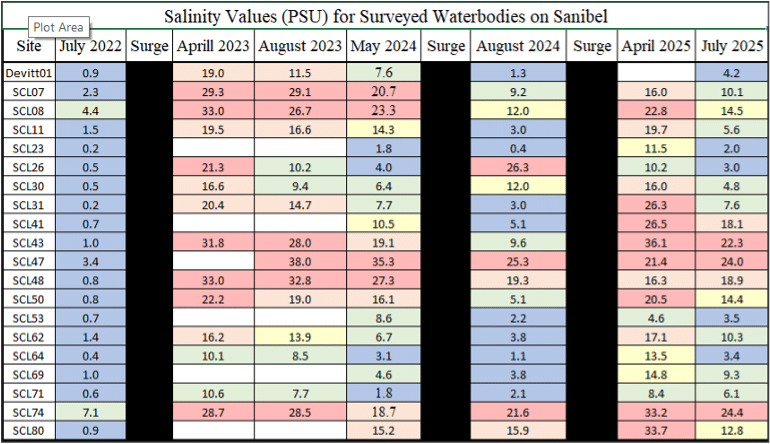
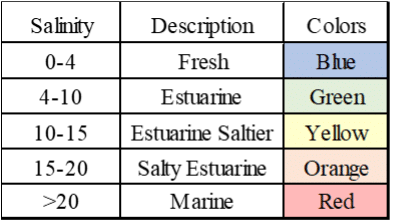
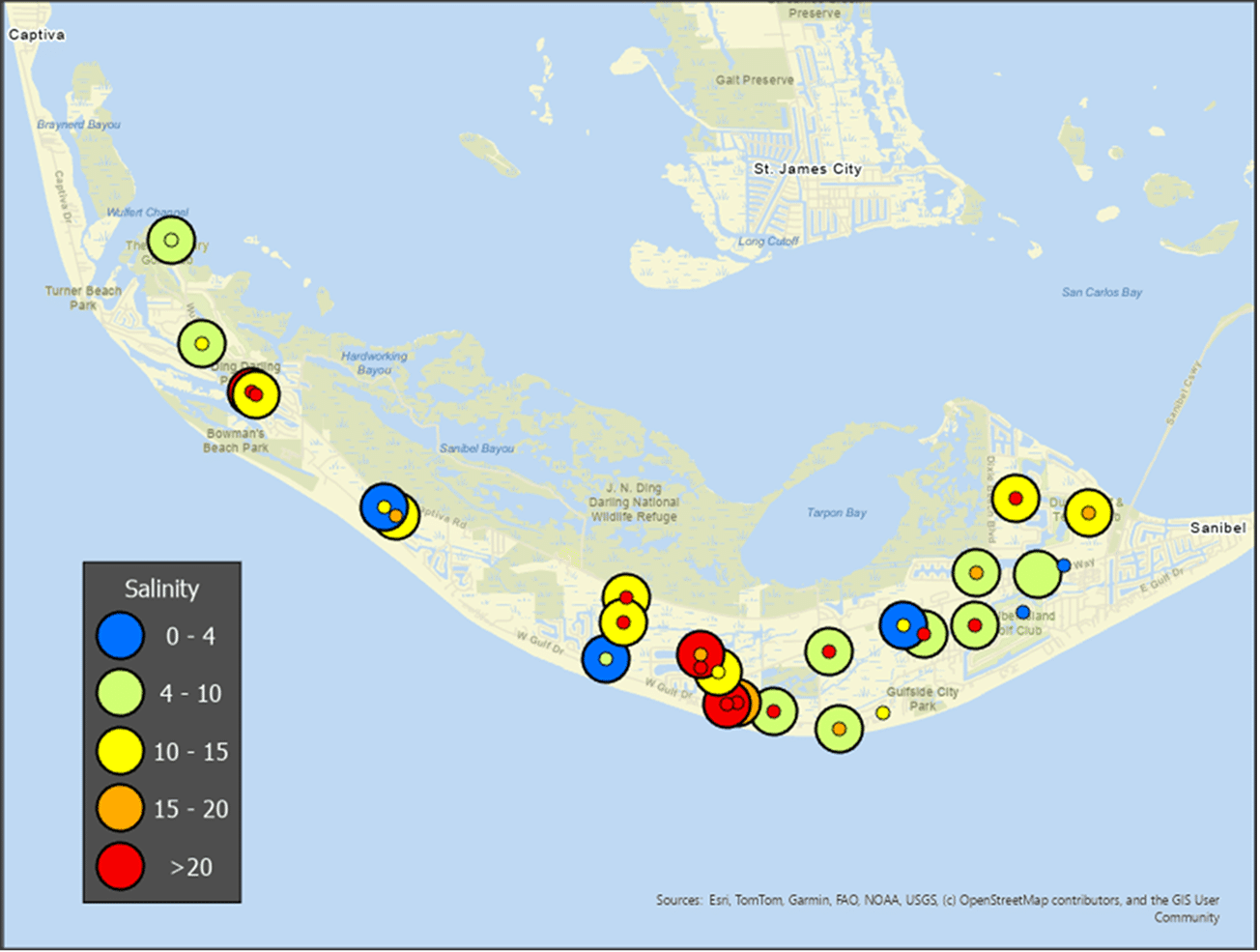
A map and table of the lakes surveyed for salinity show that there is no area on Sanibel not affected by the surges. On the map, salinity readings in July are shown by the large circles, and the small inner circles are salinity readings taken in April. Blues and greens are less salty areas, while yellow, orange, and red are high salinity. All waterbodies did become fresher in June.
The rains of last month also resupplied Sanibel’s surficial groundwater aquifer.
The 39 groundwater sites monitored by SCCF showed an average rise in groundwater of 1.4 feet in June. The groundwater supplies all of the island’s surface water bodies in the wet season, helping to speed their recovery.
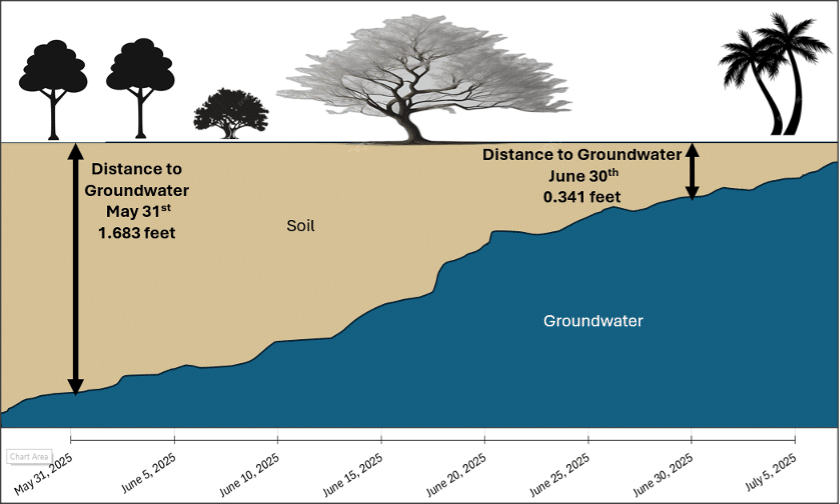
Many of the groundwater monitoring sites now have water standing on them. This is typical of the wet season on Sanibel, which has substantial wetlands. However, after Ian, Debby, Helene, and Milton, Sanibel’s vegetation quality and quantity have decreased.
What will it take to fully revive freshwater systems?
Studies by the USGS, Johnson Engineering, and SCCF have found that the vast majority of water that falls as precipitation on Sanibel is removed through plant evapotranspiration, particularly through trees.
“Trees pump water up from the groundwater aquifer, store a significant amount within their trunks, and lose water through their pores,” said Thompson. “With the great loss of vegetation from four consecutive storms, precipitation that now falls on Sanibel takes a greater amount of time to be removed from areas with standing water.”
The remainder of the wet season will bring more precipitation, which will continue to raise groundwater levels and lower the saltiness in waterbodies, providing relief to the strained freshwater systems that once covered Sanibel.
“If we can avoid storm surge for a few more years, Sanibel will have thriving freshwater systems again. If we have additional surge events in the upcoming seasons, Sanibel will find it difficult to maintain freshwater ecosystems as it has in the past,” he adds.