
Stay in the know about wildlife, water quality, and ecosystems on Sanibel and Captiva Islands and in Southwest Florida
First Chicken Turtle Found on Sanibel Since Hurricanes Helene and Milton
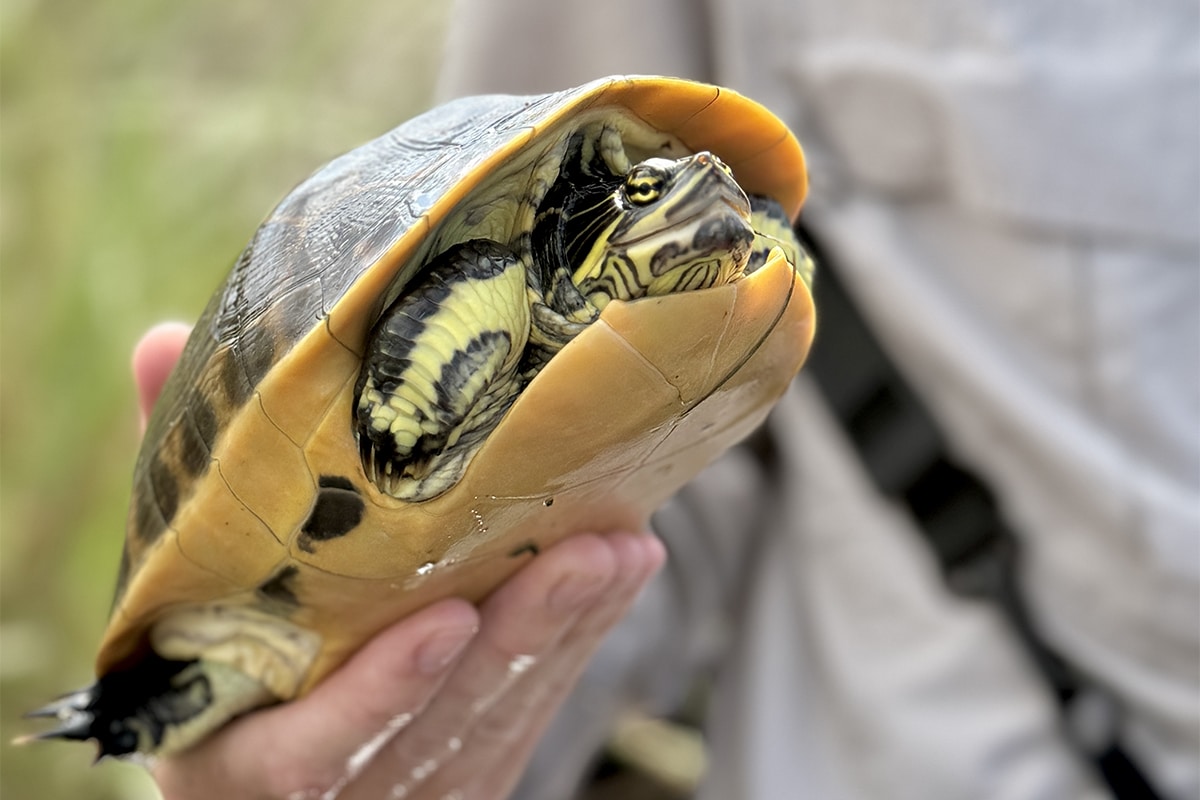
A rare Florida chicken turtle (Deirochelys reticularia chrysea) was discovered during one of SCCF’s biological surveys on July 4. This was the first individual seen since Hurricanes Helene and Milton caused major storm surge events on Sanibel in September-October of 2024.
The Florida chicken turtle is an ephemeral freshwater turtle that is only active at certain times of the year. They live around temporary water bodies and remain dormant in the dry season (known as aestivation) until the proper amount of water collects in wetlands during the wet season.
“Populations of these turtles are especially scarce on barrier islands because they need freshwater and feed mostly on crayfish, tadpoles, and fish,” said SCCF Wildlife Biologist Mike Mills. “The Florida chicken turtle’s reliance on ephemeral wetlands and seasonal foraging habits leaves it especially vulnerable to storm surges that disrupt these delicate, temporary freshwater habitats by increasing the salinity.”
In 2020, SCCF began a radio telemetry study on Florida chicken turtles on Sanibel, enabling biologists to monitor individual turtles’ movements to assess their home range sizes and habitat use patterns, also known as its spatial ecology. The newly found chicken turtle was affixed with a radio tag for this purpose.
“Gaining insight into a species’ spatial ecology is essential for informing effective conservation and management strategies,” Mills said. “This is even more important for understudied species like the Florida chicken turtle — specifically for at-risk populations like the one on Sanibel Island.”
Following Hurricane Ian in September 2022, salinity levels in wetlands occupied by Florida chicken turtles on Sanibel exceeded 20 practical salinity units (PSU), approaching the Gulf’s average salinity of 32 PSU.
“Chicken turtles were found deceased along the edges of these wetlands, indicating the salinity levels exceeded the species’ tolerance,” Mills said. “This occurred again after Hurricanes Helene and Milton, with all radio-tracked chicken turtles either found deceased, or their signals were lost due to transmitters being corroded by saltwater.”
The detection of a Florida chicken turtle following three major storm events shows the potential resilience this species may have towards extreme weather disturbances, Mills said. However, observed mortality events post-hurricane, combined with ongoing threats such as habitat loss, illegal collection for the pet trade, and road mortality, underscore the species’ vulnerability.
“Continued data collection from this newly radio-tagged individual will contribute valuable insight into the ecology and conservation needs of this imperiled species, not just on Sanibel, but for populations around the state of Florida,” Mills said.