
Published Research
Variation in Bivalve Larval Density and Settlement of the Eastern Oyster (Crassostrea virginica, Gmelin 1791) in a Modified Estuary
May, Melissa A., Markell, Grace, Jose, Felix, and Milbrandt, Eric C.
Published In 2025
ABSTRACT
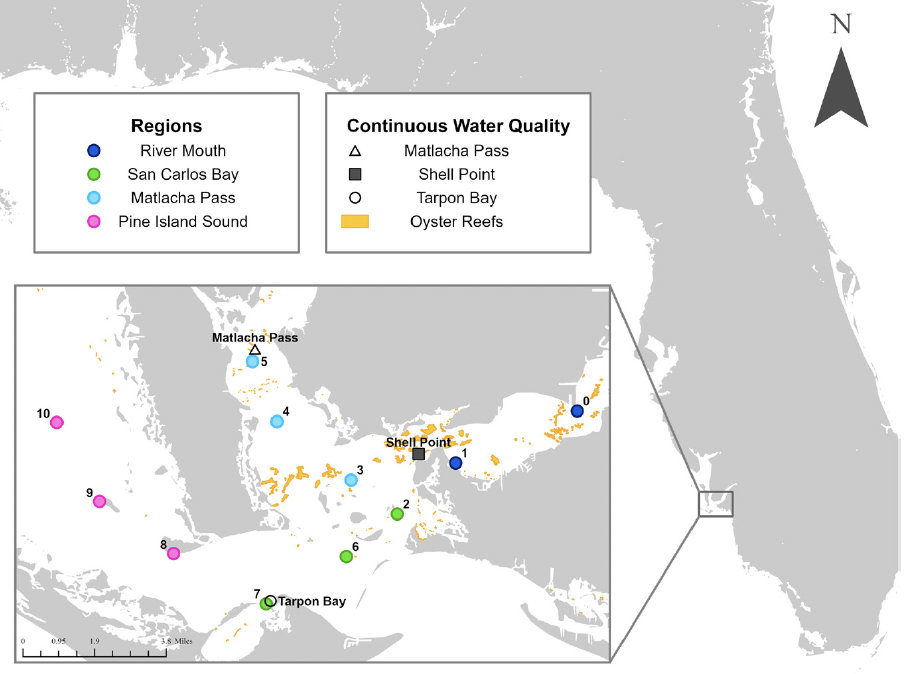
Estuaries globally are changing due to rapid land use transformation, degrading water quality, human activity, and climate change. Oyster reefs are common and important habitats in estuarine systems across North America, providing numerous services that contribute to the health of these ecosystems. Yet, a paucity of oyster reef habitat data exists, particularly in estuaries with limited or no commercial harvest. Even less information is available on oyster larval supply, patterns of recruitment, and their impact on oyster population resilience. Bivalve larval distributions and patterns of oyster settlement were monitored at sites across the lower Charlotte Harbor Estuary, FL, from 2020 to 2023 to better understand drivers of oyster reef decline, as well as the implications of early life stage distributions on future restoration efforts. In this study, both bivalve larval density and oyster settlement varied by year and across regions within the estuary. Densities of bivalve larvae and spat increased with distance from the mouth of the Caloosahatchee River, where high densities of living oyster habitat are found. Bivalve larval abundance was strongly correlated with temperature and food availability, but surprisingly not salinity. Oyster settlement showed a positive correlation with temperature and a slight negative correlation with salinity. For both metrics, no clear patterns emerged to explain temporal and spatial variation, even following major disturbances (e.g., Hurricane Ian, FL red tide, heat wave event). These results suggest that bivalve larvae and oyster spat in Southwest Florida are resilient to environmental stressors and that both are abundant throughout the Charlotte Harbor Estuary over the duration of the oyster spawning season. Furthermore, substrate may be limiting population recovery in the region and restoration efforts to place shell would likely be successful.