
Stay in the know about wildlife, water quality, and ecosystems on Sanibel and Captiva Islands and in Southwest Florida
Meet the Natives: Wild Tamarind
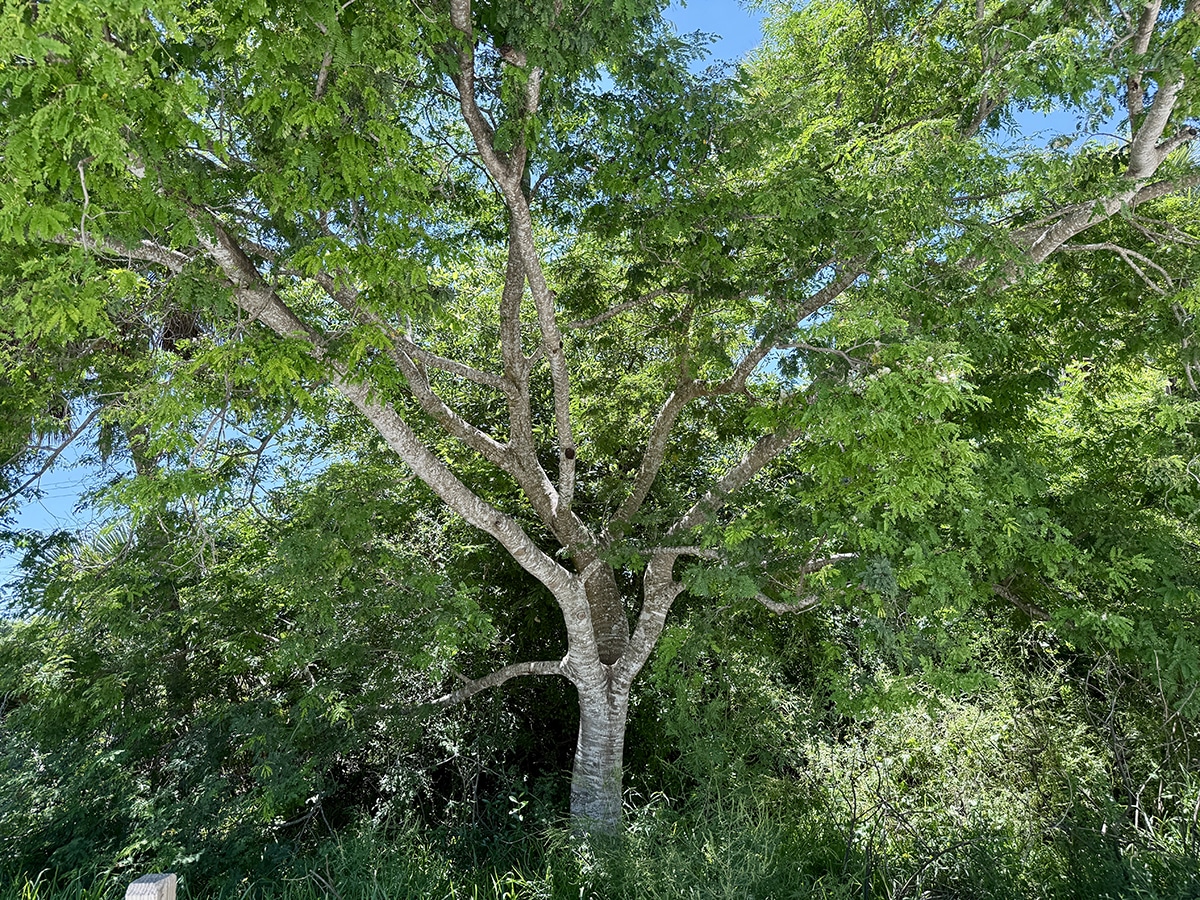
This week we are talking about wild tamarind (Lysiloma latisiliquum). This long-lived tree is a member of the Fabaceae, or pea, family.
Wild tamarinds are adaptable trees often found in open or recently disturbed sites, and tropical hammocks. It is found growing in South Florida and into the Florida Keys. Once established, wild tamarind are relatively drought and salt tolerant, with the ability to survive occasional saltwater inundation.
Typically, wild tamarind prefers full sun and moist to well-draining soils. They can grow 40-60 feet high, and are relatively quick growing.
“Wild tamarind make excellent shade trees,” said SCCF Native Landscapes & Garden Center Assistant Sophie Carpenter.
Because wild tamarinds are members of the pea family, they are able to ‘fix’ atmospheric nitrogen. This unique adaptation likely gives these trees an advantage in nutrient-poor sites, and can help enrich surrounding soil for the benefit of other nearby plants.
“They flower primarily in the spring producing unique pom-pom like blooms,” Carenter said. “Typical of members of the pea family, wild tamarind produce seed pods following their blooms.”
Their leaves are bi-pinnatley compound and are wispy and fern-like.
“Unfortunately, wild tamarind are often confused with the invasive Lead tree (Leucaena leucocephala), due to their similarity in leaf and flower appearance. Wild tamarind typically have fewer pinna per leaflet than lead tree,” Carpenter said.
Wild tamarind are the larval host plant for three of Florida’s native butterflies: the Mimosa yellow (Pyrisitia nise), Cassius blue (Leptotes cassius), and Orange sulphur (Colias eurytheme). Its fragrant flowers attract both native butterfly and bee species.
“The tree’s large canopy provides shelter and habitat for many small birds, and is also an important habitat for native tree snails,” Carpenter said.
Learn more or purchase wild tamarind at SCCF’s Native Landscapes & Garden Center at 1300 Periwinkle Way, Sanibel, FL.