Stay in the know about wildlife, water quality, and ecosystems on Sanibel and Captiva Islands and in Southwest Florida
Shorebird Nesting Recap: 7 Snowy Plover Chicks Fledge on Sanibel
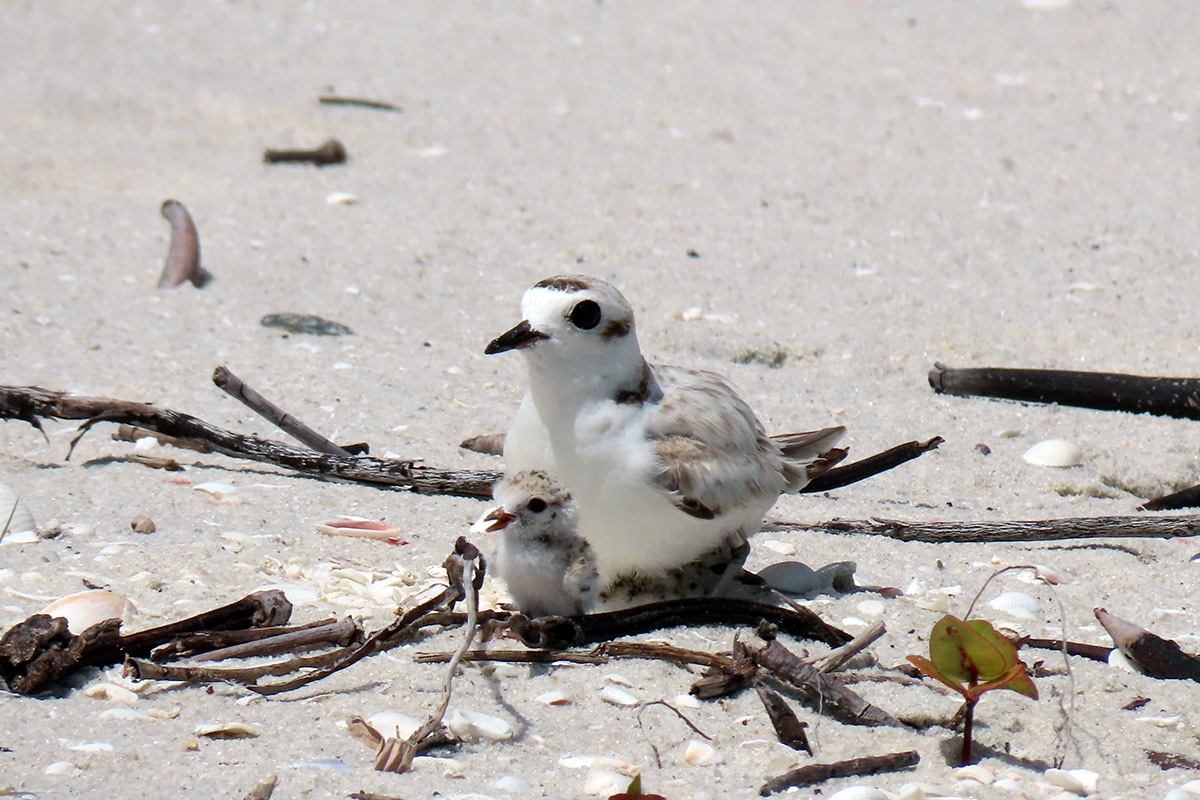
Shorebird nesting season in Southwest Florida is coming to an end, and SCCF shorebird biologists were pleased to see nesting success in multiple species we monitor, including snowy plovers, least terns, and Wilson’s plovers.
SNOWY PLOVERS
Snowy plovers (Anarhynchus nivosus) had a much more successful nesting season this year compared to 2024, which was the first time that zero snowy plover chicks have fledged on Sanibel since SCCF began consistently monitoring the state-threatened shorebirds in 2002.
There were seven snowy plover nesting attempts this season from seven different pairs, with seven chicks surviving to fledge.
SCCF biologists banded chicks in order to track their movements. One of the fledged chicks has already been sighted in Fort DeSoto.
“Changes to the beach following Hurricane Milton led to the creation of a large foraging area that allowed the plover’s chicks to grow and fledge at a rapid rate,” said Shorebird Biologist Audrey Albrecht.
LEAST TERNS
Least Terns (Sternula antillarum) saw their most successful year on the Sanibel Causeway Islands in over 30 years.
“Through our partnership with Florida Fish & Wildlife Conservation Commission and Lee County Parks & Recreation, along with a volunteer stewarding program, SCCF monitored a large colony,” Albrecht said. “At peak nesting, there were 114 chicks and 142 nests present in the colony, indicating that close to 200 nests were likely laid.”
Total colony surveys suggest that over 200 chicks successfully fledged from the colony. These fledglings could be seen flying around Sanibel, Bunche Beach, and the Causeway Islands.
“Due to the asynchronous nature of colonial nesting, getting an exact count presents a challenge,” Albrecht explained.
KILLDEER
This season, there was an apparent increase in Killdeer (Charadrius vociferus) nesting on Sanibel. SCCF monitored 13 nests, though many more were present across the island.
“Habitat restoration efforts on preserve land led to more desirable habitat in previously unsuitable areas,” Albrecht said. “The shorebird team plans to continue monitoring changes in the killdeer nesting population on the island going forward.”
OFF-ISLAND MONITORING
SCCF also monitors shorebird nesting at off-island sites in partnership with the Florida Department of Environmental Protection, FWC, U.S. Fish & Wildlife Service, and Lee County Parks & Recreation.
At Estero Bay Preserve State Park and McGregor Preserve, biologists monitored black-necked stilt (Himantopus mexicanus) and Wilson’s plover (Charadrius wilsonia) nesting.
Bunche Beach had both Wilson’s plovers and least terns nesting this year. At least nine pairs of Wilson’s plovers hatched and fledged chicks at the site. Least terns were less successful, only hatching two chicks from 14 nests, and fledging none. A small colony of terns were also found nesting on North Captiva, however the nests were lost to an unknown predator.
“The shorebird team will continue to monitor our sites year-round for non-breeding surveys,” Albrecht said. “Our next survey will be for World Shorebirds Day, an annual event which SCCF has contributed to since 2016.”