Stay in the know about wildlife, water quality, and ecosystems on Sanibel and Captiva Islands and in Southwest Florida
Venomous Snakes in Southwest Florida
No verified sightings of venomous snakes have been documented on Sanibel and Captiva Islands in recent years.
There are 4 venomous snakes found in Southwest Florida. They consist of the eastern diamondback rattlesnake (Crotalus adamanteus), dusky pygmy rattlesnake (Sistrurus miliarius barbouri), Florida cottonmouth (Agkistrodon piscivorus conanti) and the eastern coral snake (Micrurus fulvius fulvius). Historically, only two of these snake species have been documented on Sanibel and Captiva Islands (eastern diamondback rattlesnake, eastern coral snake). There have been several unconfirmed sightings of dusky pygmy rattlesnakes and Florida cottonmouths on Sanibel. For a snake to be documented, there must be a photograph, a DOR (Dead-on-road example), a preserved specimen, or a live example that more than one person can verify. If one person witnesses a snake but does not provide any of the examples listed above, then it is considered an unconfirmed sighting.
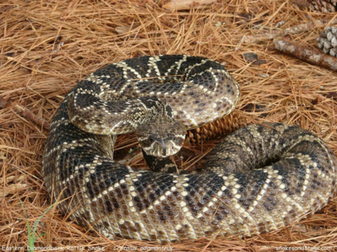 Eastern diamondback rattlesnakes (left) are large snakes (can reach over 5′ in length). They occur on the mainland as well as barrier islands throughout Florida, Georgia and South Carolina. They have been documented from Sanibel, Captiva, North Captiva, Cayo Costa and Gasparilla Island as well as the Keys. They are in the Family Viperidae, which makes them pit vipers. The word pit viper refers to the loreal pits on the side of head that enable to them to sense heat from their prey (small mammals and birds). They are hide and ambush predators which means that they hide themselves and wait for small mammals such as rats, rabbits and birds to pass by. They strike (bite) the animal with lightning speed and wait for the animal to die from envenomation. They are able to to follow the path of the dying animal with their loreal pits and finally swallow the animal after it is found.
Pit vipers have cytotoxic venom, meaning the venom dismantles the molecular structure of the area to aid in digestion of the prey. Eastern diamondback rattlesnakes are large, venomous snakes that can deliver considerable amounts of venom. There have been fatalities from eastern diamondback rattlesnake bites. However, eastern diamondbacks are not considered aggressive. Their main method of defense is their ability to remain motionless and camouflage themselves around vegetation. Most of the time, people walk right past diamondbacks without even noticing them. Normally, they will not rattle their tail until they realize they have been seen. Human bites are rare and usually involve that person trying to maneuver the snake by hand or with a stick. The last documented eastern diamondback rattlesnake sighting on Sanibel was in 1996. It is unknown and doubtful that this species is still reproducing on Sanibel but there may be a few isolated animals left in “remote” parts of the island. A neonate eastern diamondback rattlesnake was found on one of the causeway islands on Oct. 1, 2015. This snake likely emigrated from Pine Island or some other nearby island as this is a colonizing species.
Dusky pygmy rattlesnakes (right) are small pit vipers that rarely exceed 2 feet in length. They are consi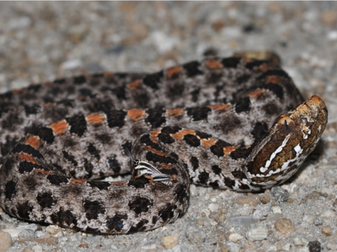 dered nervous and irritable and do not like being harassed. They are usually very quick to rattle their tail and will strike with very little disturbance. However, their first line of defense is to flee. Their venom is of equal or greater potency to eastern diamondback rattlesnakes but they inject smaller doses of venom which makes them less dangerous.
Dusky pygmy rattlesnakes are not common on barrier islands in southwest Florida. In fact, they have not been documented on Sanibel, Captiva, North Captiva, Cayo Costa or the Keys. However, there have been numerous unconfirmed reports from Sanibel. Mostly, the snake in question ends up to be a juvenile southern black racer (Coluber constrictor priapus). However, this does not discount the possibility of their presence in small numbers on Sanibel or Captiva. Many native and non-native animals arrive to Sanibel by plant shipments, sod trucks, pine straw bails or other accidental methods of transportation. It is not beyond possibility that a few stowaways may have arrived to Sanibel or Captiva, but as of yet, there is no documented proof.
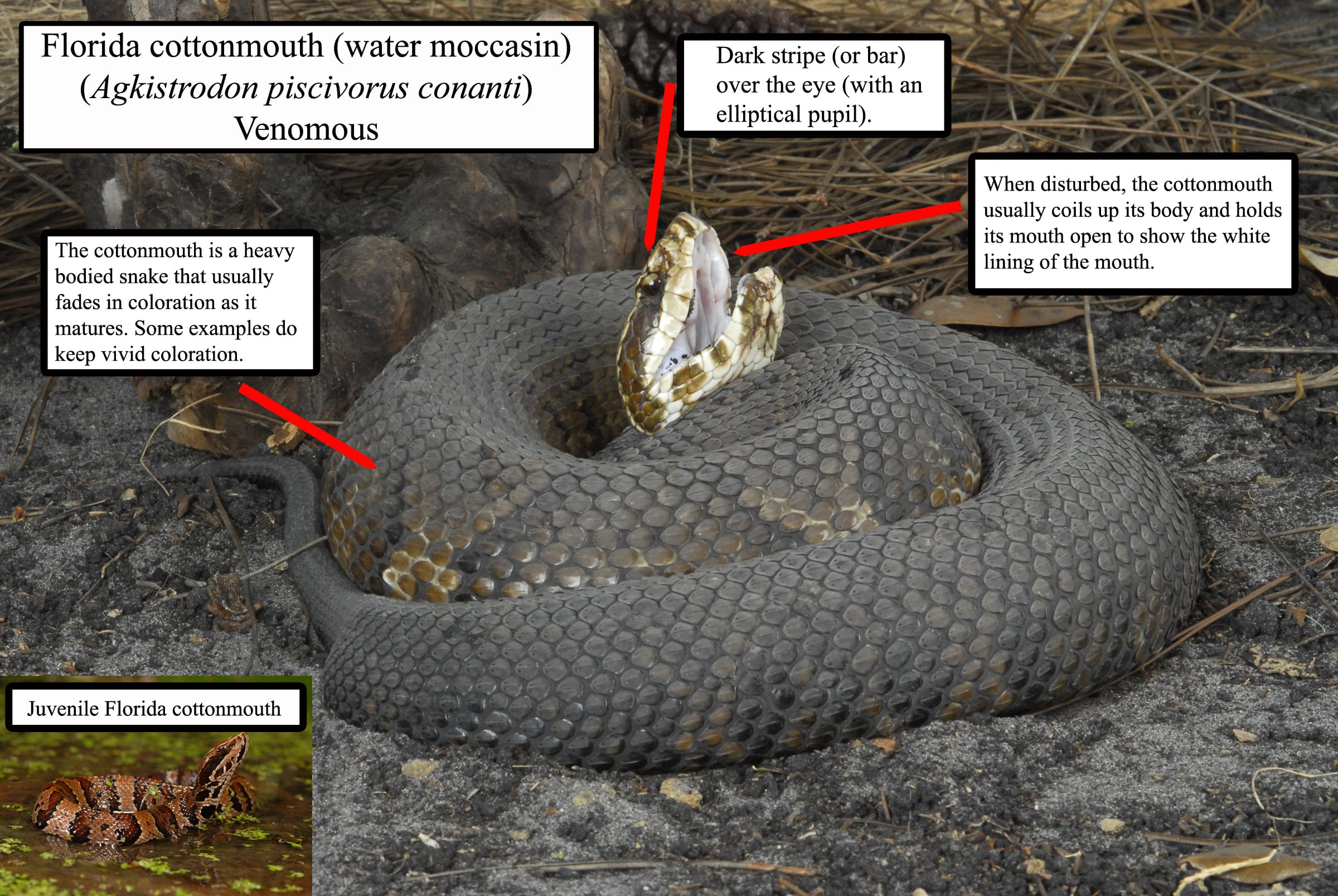
The Florida cottonmouth (left) is a medium-sized aquatic pit viper that rarely exceeds four feet in length. The other common name for this snake is a water mocassin Their temperament is considered bullish or bold. They will usually retreat when approached but often hold their ground. If they decide to hold their ground, the first thing they do is coil up. This is usually followed by opening their mouth to show the white lining in their mouth. At this point they usually will not move until the danger has passed. They will strike profusely if they are harassed while in the coiled position.
They eat a variety of animals including fish, frogs, snakes, small mammals, and birds. They are often mistaken for nonvenomous watersnakes throughout Florida and many parts of the country. They have never been documented on any island in Pine Island Sound, although unconfirmed reports are made periodically. This snake may have been brought to Sanibel by the transportation of goods (retail plants, pine straw, sod pallets) from off island but there is no solid evidence to prove its existence at this time.
The snake can be considered dangerous because of the potency and volume of venom that it can administer. However, you are as likely to be bitten by this snake as you are by any other snake. Most bites are from people harassing them. They are often mistaken for Florida watersnakes (Nerodia fasciata) and mangrove watersnakes (Nerodia clarkii) on Sanibel and Captiva.
The fourth venomous snake 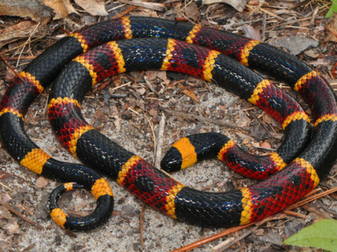 found in southwest Florida is the eastern coral snake (right). This snake is not a pit viper but an elapid, Family Elapidae (like a cobra or mamba). Elapid snakes have neurotoxic venom. This venom works differently than hemotoxic or cytotoxic venoms (pit vipers). The venom attacks the central nervous system which results in difficulty breathing, speaking, walking, etc. Envenomations usually results in paralysis, unconsciousness and often death. However, very few people get bit by coral snakes in the United States (less than 1% of venomous snake bites). About half of bites on humans are dry bites (bites without envenomation) due to the coral snake having non-retractable small fangs (unlike pit vipers) in the front of its mouth. Coral snakes tend to hold on when they bite to administer venom while pit vipers strike quickly.
This snake is non-aggressive. It is very shy and will try to escape when approached. I have never heard of a case where someone was bitten when they were not trying to capture or maneuver the animal. The last documented coral snake on Sanibel was in 2002. There have been several unconfirmed sightings since then. This snake could still be present on Sanibel due its secretive nature.
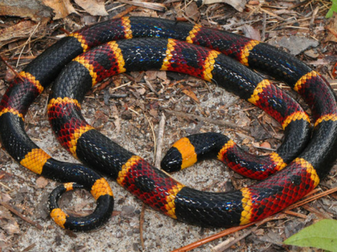
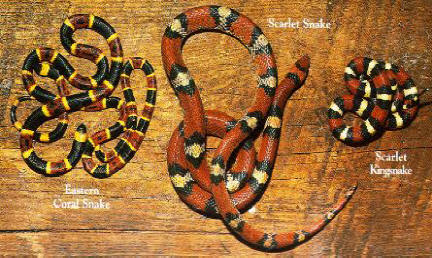
The eastern coral snake is a very obvious snake. It has black, red and yellow (or white) bands that run 360 degrees around the snake. It is rarely over three feet long. There are two mimic snakes in Lee county that could be misidentified as coral snakes, but neither of them are extant on Sanibel. They are the scarlet kingsnake (Lampropeltis triangulum elapsoides) and the scarlet snake (Cemophora coccinea). The ol’ rhyme for idenifying coral snakes in the United States is as follows: “Red on black, friend of Jack, red on yellow, kill a fellow”. Basically, if the yellow/white bands separate all of the red and black bands, then it is a coral snake. If any of the red bands touch any of the black bands, then it is nonvenomous. This formula is only true for coral snakes in the United States. In Cental and South America, coral snake coloration is inconsistent with this rhyme.
Other notes of interest:
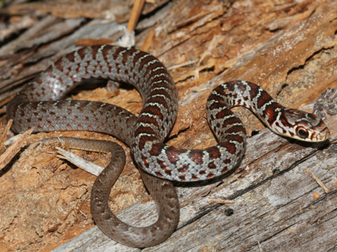 The most misidentified snake in south Florida is also the most common snake – the southern black racer. The juvenile black racer (left) is commonly mistaken for pygmy rattlesnakes. It will coil up, rattle its tail and strike readily resembling a pygmy rattlesnake. Notice the round pupils with the very large eyes. Racers are highly diurnal relying on good eyesight. Some other interesting facts about these venomous snakes are that the three pit vipers (2 rattlesnakes and cottonmouth) are ovoviviparous which means that they appear to have live young (the eggs are incubated inside the mother and the young arrive in thin sacs during birth). Elapids (coral snake) are oviparous which means that they lay eggs and the eggs incubate in the environment.
All of our local pit vipers have elliptical pupils and the coral snake has round pupils. All pit vipers have a brown blotch or line that lines up with the snakes eye. This is to conceal the actual position of the eye. There is not a recorded case of a single fatality from the bite of a pygmy rattlesnake, however there have been fatalities from eastern coral, eastern diamondback rattlesnakes, and Florida cottonmouths.
All of these snakes are very important components of our local ecosystem. They perform a role in the food web and their purpose is not to bite people. It takes a lot of energy to make venom. After they use their venom, it takes several weeks to rebuild their supply. About 25% of pit viper bites are dry bites, and about 50% in coral snake bites. If you accidentally step on a venomous snake, it will probably bite so be mindful.
If you come across a venomous snake on Sanibel or Captiva please leave it alone. If you have a camera, please take a picture of it (from a safe distance) and send it to Chris Lechowicz (clechowicz@oldsccf.blackbaudwp.com)